Which ISO Certification Is Best for Small Businesses? A Practical Guide for MSMEs
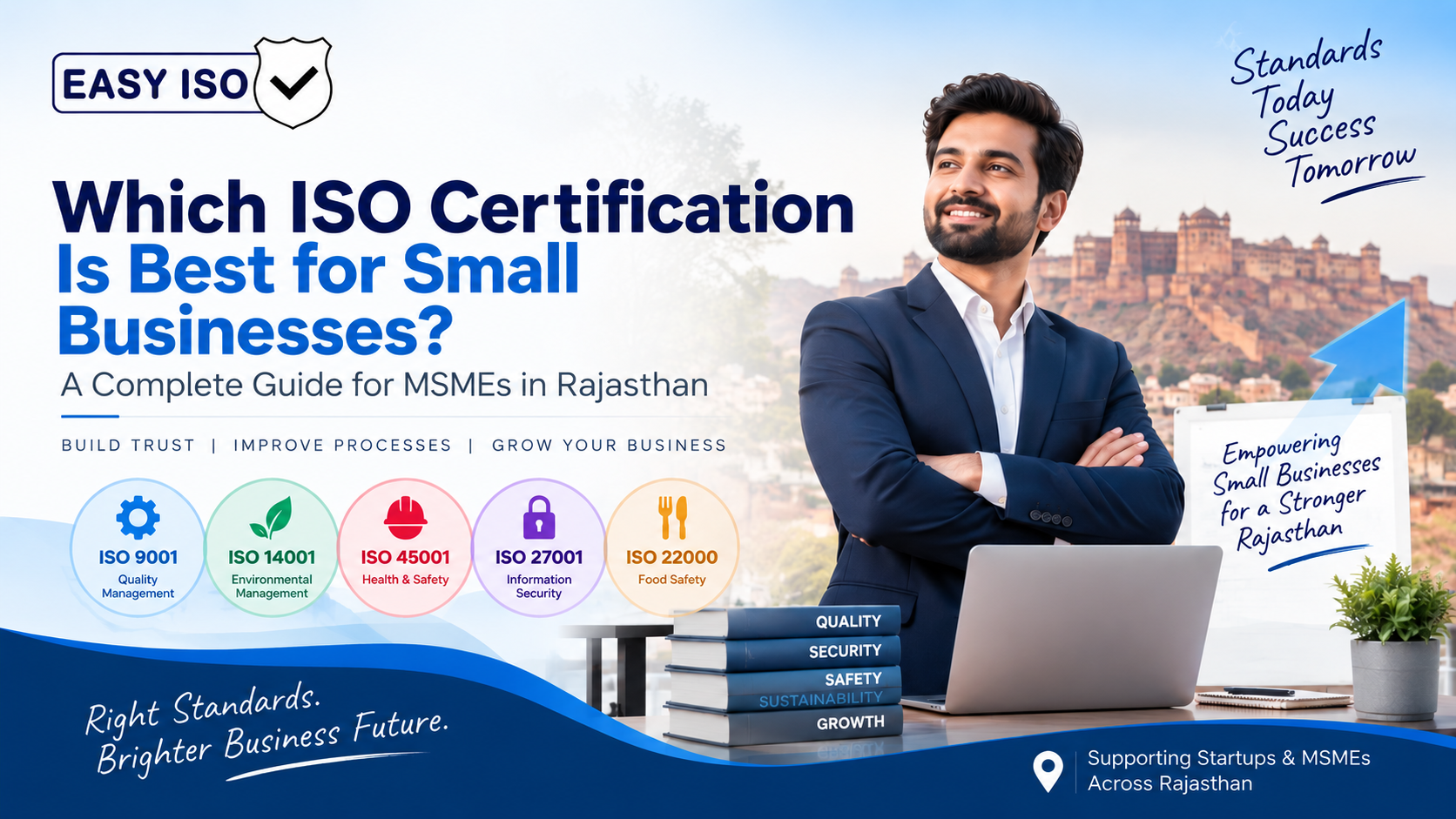
Which ISO Certification Is Best for Small Businesses
08 Sep 2026
Running a small business comes with a long list of priorities: winning customers, controlling costs, maintaining quality, managing employees and preparing for growth. As the business expands, customers and business partners may also begin asking an important question: Do you have ISO certification?
But obtaining an ISO certificate should not be approached as simply buying a certificate. The right ISO management system should address a genuine business requirement and support better processes, risk management and customer confidence.
So, which ISO certification is best for small businesses?
There is no single ISO standard that fits every organization. For many businesses, ISO 9001 certification is an excellent starting point because it addresses quality management and process consistency. However, an IT company handling sensitive information may need ISO 27001, a food business may need ISO 22000, and a manufacturing organization concerned with workplace safety may consider ISO 45001.
The right choice depends on your industry, activities, customers, risks, legal requirements and business objectives.
What Is ISO Certification for Small Businesses?
ISO certification is the formal confirmation that an organization's management system has been assessed against the requirements of a particular ISO standard by a certification body.
A small business can implement a management system just as a large organization can. However, the system should be appropriate to the organization's size, complexity and activities.
For example, a five-person consultancy does not need the same level of documentation and operational complexity as a large manufacturing facility.
This is why professional ISO consultation starts with understanding the business rather than recommending the same certification to everyone.
For startups and MSMEs, an appropriate ISO management system can help establish structured processes early and create a stronger foundation for sustainable growth.
Which ISO Certification Is Best for Small Businesses?
The best ISO certification depends on what your business needs to control or improve.
| ISO Standard | Main Focus | Businesses That May Benefit |
|---|---|---|
| ISO 9001 | Quality Management | Most industries, manufacturers, service providers, traders, startups and MSMEs |
| ISO 27001 | Information Security | IT, software, SaaS, BPO, data-driven businesses |
| ISO 14001 | Environmental Management | Manufacturing, industrial, construction and environmentally sensitive operations |
| ISO 45001 | Occupational Health & Safety | Manufacturing, construction, engineering, industrial businesses |
| ISO 22000 | Food Safety | Food manufacturers, processors, suppliers and food-service businesses |
| ISO 13485 | Medical Devices Quality | Medical device manufacturers and related organizations |
The table provides a general direction. A business should select the standard according to its actual scope and applicable requirements.
ISO 9001: The Most Versatile Choice for Small Businesses
When business owners ask, “Which ISO certification should a small business get?”, ISO 9001 is often the first standard to evaluate.
ISO 9001 specifies requirements for a Quality Management System (QMS). Its objective is to help organizations consistently provide products or services that meet customer and applicable requirements while improving the effectiveness of their processes.
ISO 9001 can be suitable for:
- Manufacturing companies
- Service providers
- Trading businesses
- Consultants
- IT companies
- Construction companies
- Educational organizations
- Healthcare organizations
- Exporters
- Startups
- MSMEs
What Can ISO 9001 Help a Small Business Improve?
A properly implemented QMS can help a business establish:
- Clearly defined processes
- Customer-focused operations
- Responsibilities and authorities
- Supplier evaluation practices
- Quality objectives
- Risk-based thinking
- Performance monitoring
- Complaint handling
- Corrective action
- Continual improvement
For a growing company, these practices can reduce dependency on informal processes and make operations more consistent.
ISO 27001 for IT Companies, Startups and Data-Driven Businesses
Modern small businesses increasingly handle customer data, employee information, financial information, intellectual property and digital assets.
For such organizations, ISO 27001 certification for small business can be highly relevant.
ISO 27001 specifies requirements for an Information Security Management System (ISMS).
It is particularly relevant to:
- Software companies
- SaaS businesses
- IT service providers
- BPO companies
- Cloud-based businesses
- Technology startups
- Data-processing organizations
- Businesses managing confidential information
An ISMS uses a structured approach to information-security risks, helping organizations identify, assess and address relevant security risks.
If information security is central to your business model, ISO 27001 may be more strategically valuable than pursuing a general quality certification alone.
ISO 14001 for Environmental Management
Environmental responsibility is increasingly relevant to manufacturers, industrial businesses, construction organizations and companies operating resource-intensive processes.
ISO 14001 certification provides a framework for an Environmental Management System (EMS).
A small or medium-sized organization can use the framework to systematically manage relevant environmental aspects and improve environmental performance.
Potential areas include:
- Waste management
- Resource consumption
- Environmental objectives
- Operational controls
- Legal and regulatory considerations
- Environmental risks
- Monitoring and improvement
ISO 14001 can also strengthen a company's environmental management approach when customers or supply-chain partners have environmental expectations.
ISO 45001 for Workplace Health and Safety
Businesses with employees working in manufacturing plants, construction sites, workshops, warehouses or other potentially hazardous environments need a systematic approach to occupational health and safety.
ISO 45001 certification focuses on an Occupational Health and Safety Management System (OH&S).
It can help organizations establish processes for:
- Identifying workplace hazards
- Assessing OH&S risks
- Implementing operational controls
- Worker consultation and participation
- Emergency preparedness
- Incident investigation
- Corrective action
- Continual improvement
For small manufacturing and engineering businesses, ISO 45001 can complement a broader quality-management strategy.
ISO 22000 for Small Food Businesses
Food businesses face a different set of risks. Food safety controls need to be integrated into the organization's operational processes.
ISO 22000 certification focuses on a Food Safety Management System (FSMS).
It can be relevant to:
- Food manufacturers
- Food processors
- Food suppliers
- Catering organizations
- Food-service businesses
- Food exporters
- Organizations involved in the food chain
For a small food business, selecting ISO 22000 should be based on the organization's role in the food chain, processes and applicable food-safety requirements.
ISO 13485 for Medical Device Businesses
Small companies operating in the medical-device sector may need a more specialized quality-management framework.
ISO 13485 is designed for quality management systems where an organization needs to demonstrate its ability to provide medical devices and related services consistently in accordance with applicable regulatory requirements.
It can be relevant to:
- Medical-device manufacturers
- Component suppliers
- Medical-device distributors
- Organizations supporting medical-device production
For these businesses, ISO 13485 should be considered alongside applicable regulatory and customer requirements.
How Should a Small Business Choose the Right ISO Certification?
Instead of choosing an ISO standard because another company has it, evaluate your business using the following framework.
1. Identify Your Core Business Activity
Start with your products, services, processes and customers.
A software company and a food manufacturer have completely different operational risks. Their management-system requirements should reflect those differences.
2. Understand Customer Requirements
Some customers, procurement departments and supply-chain partners may specify particular standards or management-system requirements.
Review contracts, tender documents and customer specifications before selecting a certification.
3. Identify Your Major Risks
Ask what could seriously affect your business.
Is the biggest concern:
- Product or service quality?
- Information security?
- Workplace safety?
- Food safety?
- Environmental impact?
- Regulatory compliance?
The answer can help identify the most relevant ISO standard.
4. Consider Your Growth Strategy
A startup planning to work with enterprise customers may have different certification priorities from a local service provider.
Think about your target customers, export plans, supplier requirements and upcoming tenders.
5. Define the Certification Scope Correctly
One of the most important parts of ISO certification is defining the scope.
The scope should accurately describe the organization's activities and locations covered by the management system.
A professional consultant can help the organization understand the appropriate scope before certification activities begin.
Benefits of ISO Certification for Small Businesses
A certification should deliver more than a framed certificate.
When properly implemented, a management system can help a small business create a more structured operating environment.
Potential benefits include:
Better Process Control
Documented and controlled processes can reduce inconsistency and clarify responsibilities.
Improved Customer Confidence
A recognized management-system certification can demonstrate that the organization follows a structured approach to its relevant processes.
Stronger Risk Management
Risk-based thinking helps organizations identify issues before they become larger operational problems.
Improved Internal Management
Defined responsibilities, objectives and monitoring can make business operations easier to manage as the company grows.
Support for Business Opportunities
Depending on the customer's requirements, certification may support supplier qualification, procurement opportunities or tender participation.
Continual Improvement
Management systems encourage organizations to monitor performance and take corrective action when problems occur.
ISO Certification for Small Businesses in Rajasthan
Rajasthan has a broad MSME ecosystem covering manufacturing, textiles, engineering, handicrafts, food processing, construction, tourism, healthcare, IT, trading and export businesses.
Companies in Jaipur, Jodhpur, Udaipur, Kota, Ajmer, Bikaner, Alwar, Bhilwara, Sikar, Pali, Bhiwadi and other Rajasthan business hubs can consider ISO certification based on their specific operational requirements.
For a Rajasthan-based small business, the process can begin with a professional assessment of:
- Business activities
- Number of employees
- Locations
- Products or services
- Customer requirements
- Existing processes
- Applicable ISO standard
- Certification scope
- Documentation and implementation needs
Easy ISO can assist organizations in understanding these requirements and preparing for the certification process.
How to Get ISO Certification for a Small Business
The certification journey generally involves several stages.
Step 1: Consultation and Requirement Assessment
Understand the organization's activities and identify the appropriate ISO standard.
Step 2: Gap Assessment
Review existing processes against the applicable management-system requirements.
Step 3: Documentation and System Development
Prepare the policies, procedures, objectives, records and other documented information relevant to the management system.
Step 4: Implementation
Put the system into practice across the defined certification scope.
Step 5: Internal Audit
Conduct an internal audit to evaluate whether the management system is implemented and effective.
Step 6: Management Review
Top management reviews system performance, objectives, risks, opportunities and improvement requirements.
Step 7: Certification Audit
An independent certification body assesses the management system against the applicable standard.
Step 8: Continual Improvement
After certification, the organization should continue maintaining and improving its management system.
The exact requirements and audit arrangements depend on the standard, organization and certification body.
How Much Does ISO Certification Cost for a Small Business?
There is no single ISO certification cost for small business.
Pricing can vary depending on:
- Selected ISO standard
- Number of employees
- Number of locations
- Certification scope
- Complexity of business processes
- Existing management-system maturity
- Documentation and implementation requirements
- Audit duration
- Certification-body arrangements
Therefore, businesses should avoid selecting an ISO provider only because it advertises the lowest price.
A proper quotation should clearly explain what services are included and what certification arrangements apply.
Why Choose Easy ISO for Your Certification Requirements?
Choosing the right ISO certification is only the first step. Proper preparation, implementation and certification coordination are equally important.
Easy ISO provides ISO certification support for businesses, startups and MSMEs looking to understand and implement relevant management-system standards.
Our support can be useful for organizations considering certifications such as:
- ISO 9001 Quality Management
- ISO 27001 Information Security
- ISO 14001 Environmental Management
- ISO 45001 Occupational Health & Safety
- ISO 22000 Food Safety
- ISO 13485 Medical Devices
- Other applicable management-system certifications
The objective is to understand the organization's requirements first and then guide it toward an appropriate certification pathway.
Frequently Asked Questions
1. Which ISO certification is best for small businesses?
There is no single ISO certification for every small business. ISO 9001 is often a suitable general-purpose choice because it addresses quality management and process improvement. However, IT companies may prioritize ISO 27001, food businesses ISO 22000, and organizations with significant workplace risks ISO 45001.
2. Is ISO 9001 suitable for small businesses and MSMEs?
Yes. ISO 9001 can be implemented by organizations of different sizes and industries. The QMS should be designed according to the organization's activities, size, complexity and certification scope.
3. Which ISO certification is best for startups?
The appropriate standard depends on the startup's business model. ISO 9001 can support general quality management, while ISO 27001 can be particularly relevant for technology startups handling sensitive information.
4. Is ISO certification mandatory for small businesses?
ISO certification is not universally mandatory for every small business. However, particular customers, contracts, tenders, industries or regulatory requirements may specify management-system or certification requirements. Businesses should check the requirements applicable to their specific situation.
5. How much does ISO certification cost for a small business?
There is no fixed price. The cost depends on the ISO standard, number of employees, locations, scope, business complexity, audit requirements and certification arrangements. A customized assessment is the best way to obtain an accurate quotation.
Conclusion: Choose the ISO Certification That Matches Your Business
So, which ISO certification is best for small businesses?
The right answer depends on your business—not simply on the popularity of an ISO standard.
For many small businesses and MSMEs, ISO 9001 provides a strong foundation for quality management and process improvement. Businesses dealing with sensitive information may consider ISO 27001. Manufacturers and industrial organizations may evaluate ISO 14001 and ISO 45001, while food businesses can consider ISO 22000.
The most effective certification strategy starts with understanding your business activities, risks, customers and growth plans.
Need Help Choosing the Right ISO Certification?
If you operate a small business, startup or MSME in Rajasthan and are unsure which ISO standard is appropriate, Easy ISO can help you understand your certification requirements and next steps.
📧 Email: info@easyiso.in
📞 Phone: +91-90797 32024
📍 Easy ISO: Ground Floor, Shop No. 11, EL - Commercia, PR 7 Road, Near Maya Garden City, Gate No. 3, Zirakpur, Punjab - 140603, India.
Contact Easy ISO today for professional ISO certification guidance and a customized quotation for your business.